जेन जी आन्दोलनको छानबिनको सम्बन्धमा बनेको कार्की आयोगको प्रतिवेदन भर्खर भर्खरै सार्वजनिक भएको छ। उक्त प्रतिवेदनको पृष्ठ ६३० मा डिजीटल युगमा अल्गोरिदमको प्रभाव शिर्षक अन्तर्गत Attention Economy को समेत चर्चा भएको पाइन्छ। यस लेख सोही Attention Economy को बारेमा रहेको छ ।
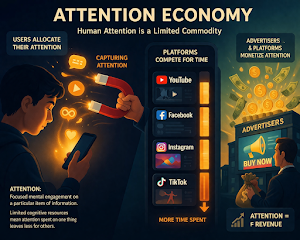
The Attention Economy: How Our Minds Became the Product
In the digital age, every scroll, click, and pause has been turned into a commodity. The race to capture human attention is not just reshaping business — it is quietly eroding the foundations of democratic life.
In 1971, the economist Herbert Simon wrote something prophetic: “A wealth of information creates a poverty of attention.” Decades before smartphones, before social media, before algorithmic feeds, Simon had already identified the central paradox of the information age. Today, his insight has become the operating principle of trillion-dollar industries.
The attention economy is the name economists and sociologists give to a market system in which human attention itself — not money, not goods, not services — is the scarce resource being bought and sold. In this economy, the companies that win are not the ones that produce the best content, but the ones that most effectively capture and hold the human gaze.
What Is the Attention Economy?
The concept was formally articulated by Michael Goldhaber in a 1997 essay, though its logic predates the internet by decades. Television networks, tabloid newspapers, and billboard advertisers all understood that their real product was not programming or ink on paper — it was the eyeballs they delivered to advertisers.
What the internet did was make this logic total. Digital platforms could now measure attention with extraordinary precision: how long you lingered on a post, which words made you stop scrolling, which images made your pulse quicken. Armed with this data, platforms could engineer experiences optimised not for your enlightenment or enjoyment, but for your continued engagement.
6.37Average hours per day spent on screens globally (2025)
**$600B+**Global digital advertising market — the engine of the attention economy
8 secEstimated average human attention span — down from 12 seconds in 2000
The Architecture of Capture
Understanding how attention is harvested requires understanding the mechanisms platforms use. These are not accidental features — they are deliberate design choices, many of them informed by behavioural psychology and neuroscience.
-Variable reward loops:
Like slot machines, infinite scrolling delivers unpredictable rewards — a funny post, a viral clip — triggering dopamine release and compulsive checking behaviour.
-Notification engineering:
Alerts are timed and worded to manufacture urgency, keeping users in a state of perpetual interruption and low-level anxiety.
-Algorithmic amplification:
Recommendation systems learn that outrage, fear, and controversy generate more engagement than measured, accurate information — and prioritise accordingly.
-Personalised filter bubbles
Feeds are tailored to confirm existing beliefs, making the world feel exactly as the user already imagines it — and strangers feel threatening.
“We have created a system that biases toward the outrageous, the emotionally provocative, and the simple — because those things hold attention. We have then handed that system the task of informing democratic citizens.”
The economist Shoshana Zuboff calls the underlying logic “surveillance capitalism”: the extraction of raw behavioural data, its transformation into predictions about future behaviour, and the sale of those predictions to advertisers and, increasingly, to political campaigns. The user is not the customer. The user is the raw material.
A Brief History of the Attention Race
1994
The first banner advertisement appears on HotWired magazine. Click-through rates of 44% — a figure never to be seen again as users rapidly developed “banner blindness.”
2004–2006
Facebook and YouTube launch. The social feed and the video recommendation engine become the dominant paradigms of digital attention capture.
2009
Facebook introduces the “Like” button. A simple mechanic transforms social interaction into quantified social validation, driving compulsive usage patterns.
2016
Cambridge Analytica harvests data from 87 million Facebook profiles for micro-targeted political advertising. The political weaponisation of the attention economy becomes undeniable.
2017–present
Former insiders — including the first president of Facebook, a founding member of Instagram, and a former Google design ethicist — publicly warn about the harms they helped engineer.
The Democratic Crisis
Democracy rests on assumptions that the attention economy systematically undermines. It assumes citizens can access shared facts, deliberate across differences, hold sustained attention on complex issues, and resist manipulation. Each of these capacities is degraded by a media environment optimised for engagement over understanding.
The effects on democracy operate across several distinct dimensions:
Epistemic fragmentation
Shared reality collapses
Outrage amplification
Civility erodes
Disinformation spread
False news travels faster
Shortened attention
Policy depth is punished
Microtargeting
Elections become manipulable
Epistemic fragmentation: When citizens no longer share the same informational world, democracy loses its most basic prerequisite: a common ground of fact. The algorithmic personalisation of news and content has fragmented what was once a shared public reality into millions of private ones — each tailored, each self-confirming, each a little more distant from the next. Political disagreement, which a healthy democracy can absorb and even thrive on, mutates into something far more corrosive when it is no longer a disagreement about what to do, but about what is real. You cannot deliberate with someone who inhabits a different universe of facts. You can only talk past them — or fear them.
Outrage amplification follows directly from the attention economy’s incentives. Algorithmic systems have discovered — through billions of data points — that negative emotions, particularly anger and moral indignation, generate more engagement than positive ones. This means that the platforms most people use to follow politics are systems that have been optimised, at enormous scale, to make politics feel like an existential conflict between good and evil. The result is a citizenry that is more polarised, more tribal, and less capable of the compromise democracy requires.
Disinformation thrives in this environment. A landmark MIT study found that false information spreads six times faster than true information on Twitter, in part because falsehoods are more novel and emotionally stimulating — exactly the qualities that attention-economy platforms reward. Conspiracy theories that once remained on the fringes can now find mass audiences through algorithmic amplification before fact-checkers have time to respond.
The shortening of attention spans has direct political consequences. Complex policy questions — pension reform, climate legislation, trade-offs in healthcare — require citizens to hold multiple considerations in mind, weigh evidence, and tolerate ambiguity. These are precisely the cognitive modes that the attention economy trains out of us. Politicians have adapted by offering simpler, more emotionally resonant messages, while careful, nuanced governance becomes impossible to communicate and therefore politically unrewarding.
Micro-targeted political advertising represents a more direct threat. When campaigns can identify specific voters and serve them personalised messages — messages no one else sees and which therefore cannot be publicly scrutinised — it becomes possible to make incompatible promises to different audiences simultaneously, to suppress voter turnout in specific communities through demoralising content, or to amplify anxieties that drive people toward authoritarian remedies. This is not a hypothetical: there is substantial evidence it occurred in the 2016 US election and the Brexit referendum.
Is There a Way Out?
The attention economy is not a law of nature. It is the product of specific choices — about business models, about regulation, about the design of technology. Which means it can, in principle, be unmade by different choices.
- Regulatory intervention: The EU’s Digital Services Act and Digital Markets Act represent significant attempts to impose accountability on platforms — requiring algorithmic transparency, banning certain targeting practices, and mandating data access for researchers.
- Platform design changes: Features like infinite scroll, auto-play, and like counts can be disabled or modified. Some platforms have experimented with “friction” — small delays or prompts that interrupt automatic scrolling and encourage reflection.
- Subscription and public models: Platforms funded by subscriptions rather than advertising have weaker incentives to maximise engagement at any cost. Public broadcasting models — imperfect as they are — have historically been more resistant to pure attention logic.
- Digital literacy education: Teaching citizens — particularly young people — how algorithmic feeds work, how disinformation spreads, and how to evaluate online sources is a long-term investment in democratic resilience.
- Antitrust action: The concentration of power in a handful of platforms has reduced competitive pressure to adopt healthier models. Breaking up dominant platforms or mandating interoperability could create space for alternatives.
- Individual practices: Notification management, screen time limits, chronological feed settings, and deliberate consumption habits can partially insulate individuals — though individual solutions are no substitute for structural change.
Conclusion: Attention Is Political
The attention economy is sometimes discussed as if it were primarily a personal health issue — a matter of distraction and wasted time. This framing fundamentally understates what is at stake. The colonisation of human attention by algorithmic systems is a political event. It changes how citizens form beliefs, how they relate to one another, how they process political information, and how susceptible they are to manipulation.
Democracy has always required certain social and informational conditions to function. It requires a citizenry capable of reason, access to accurate information, the possibility of genuine deliberation, and some degree of shared reality. The attention economy is working, systematically and at enormous scale, against every one of these conditions.
This does not mean democracy is doomed. It means that defending democracy in the 21st century requires, as one of its central tasks, reclaiming collective control over the systems that mediate our attention. In a world where attention is the primary resource being extracted and sold, the question of who controls that extraction is, inescapably, a question of power.
“The most powerful force in the modern world may not be an army or an economy. It may be an algorithm that has learned, from observing billions of humans, exactly which emotional frequencies cause people to forget their own better judgment.”
AI tool is also used while preparing this Article.
Thanks.